
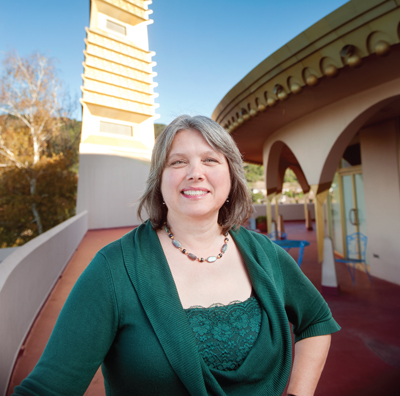
“I enjoy meeting my neighbors to chat about their various areas of concern.” At face value, that is a rather harmless statement. However, when coming from Marin County Supervisor Susan Adams (it’s from the opening page of her website), it could spell a world of trouble. Keep in mind, Adams’s “neighbors” are the nearly 65,000 people living in Marin County’s Supervisory District 1, which includes San Rafael and the communities of Terra Linda, Santa Venetia, Peacock Gap, Marinwood, Dominican and Lucas Valley. And don’t forget about all their “various areas of concern.”
“I really mean it, I love my job,” says Adams. “Even when people get a little cranky.” At age 53, divorced and with no children living at home, Adams does appear ready and able to work almost around the clock at the challenging task of being a Marin County supervisor. “Typically, I’m out of the house by seven, have a first meeting by eight, then more meetings and more meetings and often my day doesn’t end until after midnight,” she says with one of her trademark smiles that often turns into a hearty laugh. “And then I answer e-mails until one or two in the morning.”
Adams’s ascent to becoming one of five Marin County supervisors is a saga of one person having the gumption—and determination—to somehow make a difference. “I’m a fifth-generation San Franciscan; when I came to Marin in 1987, I never thought I’d someday be where I am today, never!” she says. At the time of her move, she was working on health issues at UCSF and developing a countywide clinical practice. “But when I’d refer a patient to a specialist, it was always to a different part of the county and usually involved two or three bus transfers.” So, in 1998, with no previous experience or political organization—and only $1,000 to spend—Adams ran for the state assembly.
“Joe Nation won that race,” says Adams, who is a registered nurse and a graduate of UCSF’s doctoral program, “but I spoke up at every forum and people seemed to resonate with my message that Marin had a seriously fractured system of delivering health care.” Emboldened by the response, she became a labor organizer on behalf of nurses, making frequent trips to Sacramento and becoming more at home in the political arena.
“Then in 2002, Supervisor John Kress chose not to run,” she recounts. “So I went for it.” After a crowded and contentious June primary, Adams learned in July that she would be in a November runoff. “Again, I ran with health care as my main issue,” she says with a hint of laughter in her voice, “but as is typical in Marin, I think I was elected because of my land use stand.” Adams was easily reelected in 2006 and intends to seek a third four-year term in 2010. “I think I have served my community pretty well,” she says. “But if my community is looking for something different, I can always go back to my nice quiet life as a professor of nursing.”
After seven years of being a supervisor, what accomplishment gives you the greatest pride?
I feel very maternal about Marin’s Health and Wellness Campus; I have my fingerprints all over that one. When I was coming into office, the county administrator talked to me about the Tobacco Settlement account and how it could be used for a capital project. So I proposed a consolidated clinic, a “one-stop shopping” location for health services that people wouldn’t need three transfers to reach. After floating the idea, I was fortunate the board agreed with me, and when George Lucas left the Industrial Light and Magic buildings in central San Rafael, we had the ideal location. The total cost was $60 million, all of it coming from Marin’s share of the settlement against tobacco companies for causing lung and heart problems nationwide, so it was a good fit.
The campus has been open for over a year; how is it going?
Terrific, just terrific. I didn’t want it to be a clinic, thinking that is where you go when you are sick. Therefore, it’s named the Marin Health and Wellness Campus. It focuses on prevention as well as healing. It is run by the county’s Health and Human Services Department and works well with several Marin nonprofits like Marin Community Clinics, Marin Community Action and Buckelew Programs. Many of the clients are with Healthy Families, Medicaid and Medi-Cal, but more and more with the economic downturn, we’re seeing folks who have simply lost their jobs and have no insurance. Frankly, it’s a handsome environment and many of the practitioners continually say they feel great working there.
You are also active with Marin’s homeless population; tell us about that. You mean Marin’s “dirty little secret”?
The one that’s not so secret anymore? Every two years the county has a homeless count and we’ve identified at least 1,700 people in Marin County who are homeless. In addition, probably another 4,000 are under-housed, meaning they’re “sofa-surfing” or living in cars, in motels or with friends in extremely crowded circumstances. Also, when I participated in the count, I met a homeless woman who was camping in Larkspur’s Madrone Canyon, near million-dollar homes.
Can you describe Marin’s homeless? And is there a solution?
First, there are the mentally ill, alcoholic and hard-to-house people often visible in central San Rafael. Then there are those who stay hidden—sleeping in cars or campsites—who have children and will not risk losing them by asking for help. Then come the Sausalito “live-aboards,” who stay in boats without adequate sanitation. Another group are the undocumented workers who live below freeway overpasses and in overcrowded situations. Also, about 35 percent of Marin’s population live below a level of self-sufficiency, and about 22 percent lack health insurance, which means they’re one serious illness away from insolvency. In addition, an estimated 1,000 children are homeless in Marin. It’s a difficult issue the county alone cannot solve. We all have to pitch in—Marin’s 11 cities, the county, the business community and our wonderful nonprofits. Solving homelessness is a job for all of us, working together.