
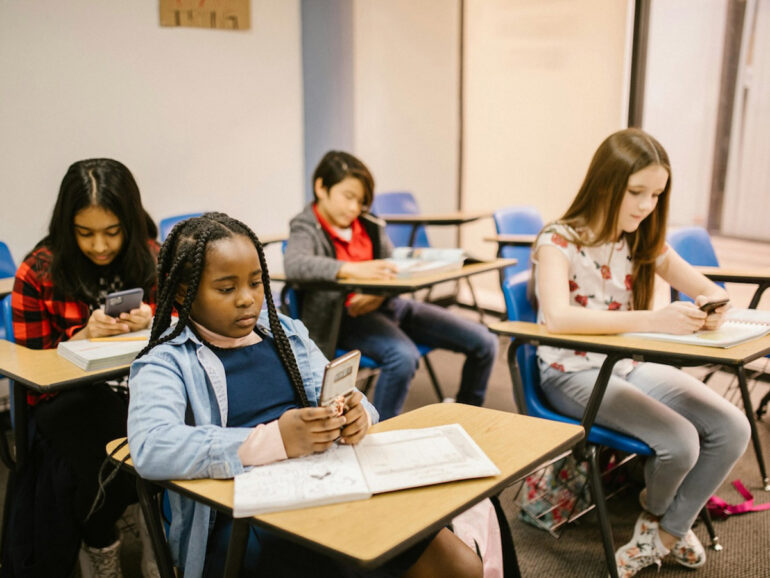
On Tuesday April 14, the Tamalpais Union High School District Board of Trustees, following the recommendation of Superintendent Dr. Courtney Goode, voted to purchase NuKase cell phone storage devices as part of a larger district-wide phone-free schools policy. Tamalpais is among several Marin County districts currently establishing a meaningful long-term “bell-to-bell” no-phone policy. These changes are in-part a response to California’s AB 3216, a statewide law requiring districts to establish restrictive cell phone policies by July 1, 2026, and also a response to a growing public awareness about the significant negative impacts of smartphone use by students on mental health and learning.
We spoke to Dr. Goode about his experience as an academic administrator in the age of cell phones, and the investment the district is making to implement a new more restrictive policy.

When you arrived at Tamalpais District from San Diego nine months ago, did you have specific policy goals around cell phone use on campuses?
I wasn’t coming in with an agenda, so to speak. Back at the dawn of the age of everyone getting a cell phone, I was principal at a 3,000 student high school in North County San Diego, and we constantly heard from teachers about the complications that are created in the classroom, most notably about being kids just on their phone at all times. At that point in the time, there wasn’t a firm district-wide policy. Our expectation was that phones would be turned off and put away during class time, but it really depended on how well that was implemented. Some teachers didn’t have an issue with taking phones from kids, turning them in, and calling the student’s home. But in other classrooms, it was a free-for-all. And that was deeply problematic.
In the first years of Yondr pouches (lockable cell phone pouches) being implemented in some schools, I went into a meeting and I said, “We need to do this. It is such a no-brainer.” And ultimately, I didn’t prevail. And so that district operated on the same policy we have had here, which has been, during class time you put the phone up in a caddy. After class time, and in between periods, breaks, and lunch, you can get the phone, and then you’re free to do whatever you want. To me, at the time, that felt like a logical and reasonable step that we took actual proactive measures to get them out of kids’ hands during class time.
So what has changed your mind since then? Why are you now in favor of a more restrictive policy?
After my principalship, in my role in HR in a high school district, it was a constant source of irritation from teachers. They said, “I am now the cell phone police. I can’t teach. I spend all my time addressing cell phone behavior.” It wasn’t until relatively recently that California has taken a much more progressive and aggressive approach to trying to limit cell phones in class. So the next logical, proactive step is to get phones out of students’ hands during the school day.
We might as well be trying to argue that the Earth is flat if we can’t acknowledge the harms of smartphone use. I read The Anxious Generation and then The Digital Delusion: How Classroom Technology Harms Our Kids’ Learning — And How To Help Them Thrive Again. The Anxious Generation very clearly spells out the harms to mental health. Jonathan Haidt dabbles in the addiction cycle. The Digital Delusion by Jared Cooney Harvath is the book that tipped me over the edge. Harvath was a teacher in Australia and he’s now a neuroscientist. He goes into great detail about how smartphones and social media harm learning, even when that phone is sitting in a caddy by the teacher’s desk. He talks about the science that demonstrates that having my phone in the caddy, knowing I can get it in 20 minutes, 15 minutes, 10 minutes, is every bit as distracting. It fragments attention every bit as much as it does when you have the phone in your hand.
Harvath then goes on further to talk about how your brain consolidates information as you learn new information. I’ll give you the analogy that he does in the book. You’re sitting in math class and you’re learning about the Pythagorean Theorem. As you learn, your brain is carving a track, like a ski track in freshly powdered snow. Then as you walk out of class and you walk to your next class, you talk with friends, you sit at a table, and eat lunch, just casual conversation, during that time your brain is consolidating that information. It’s like it skis down the same slope, again and again. It’s carving a deeper path into your brain. When you go to sleep at night, your brain then kind of permanently carves a track. and that’s how you recall that information and process that information. That’s how learning happens. But instead, if you walk out of class and immediately you have the high octane content of social media, YouTube, whatever you are looking at, your brain is not consolidating that information. And your brain is then not consolidating that information when you go to sleep at night. And he attributes this to why you see diminished learning and diminished cognition in kids today versus kids two decades ago.

What is the response to a fully restrictive “bell-to-bell” policy from the community?
I just got an email from a parent, a dad, urging us to adopt the policy, and he wrote, “I think in the not so distant future, we will look back on this time of unfettered cell phone access much like we look back on the time when the smoking section was allowed in high school.”
Is there a constituency still resisting or speaking up?
I have received feedback from very broad focus groups. Teacher leaders from all the campuses readily acknowledge that smartphones and social media are harmful to kids’ learning, socialization and wellbeing, and we should do something more about it.
I am getting lots and lots of emails. I haven’t counted, so this is not scientific – and it’s not a popularity contest either – but it seems as though it’s about thirty to one; thirty emails in favor of the phone ban to one saying, “Don’t do it.” The ones that are in favor are commenting on science. People are reading the studies. Beyond that, the fact that they’re coping with it in their homes as well. We’ve let children down, in school and beyond school.
Our new phone free school policy means kids do not have access to their phone from the moment they walk on campus in the morning until they leave campus at the end of the school day.
The district will purchase a NuKase for each student to lock up their phone for the entire school day. How will this work?
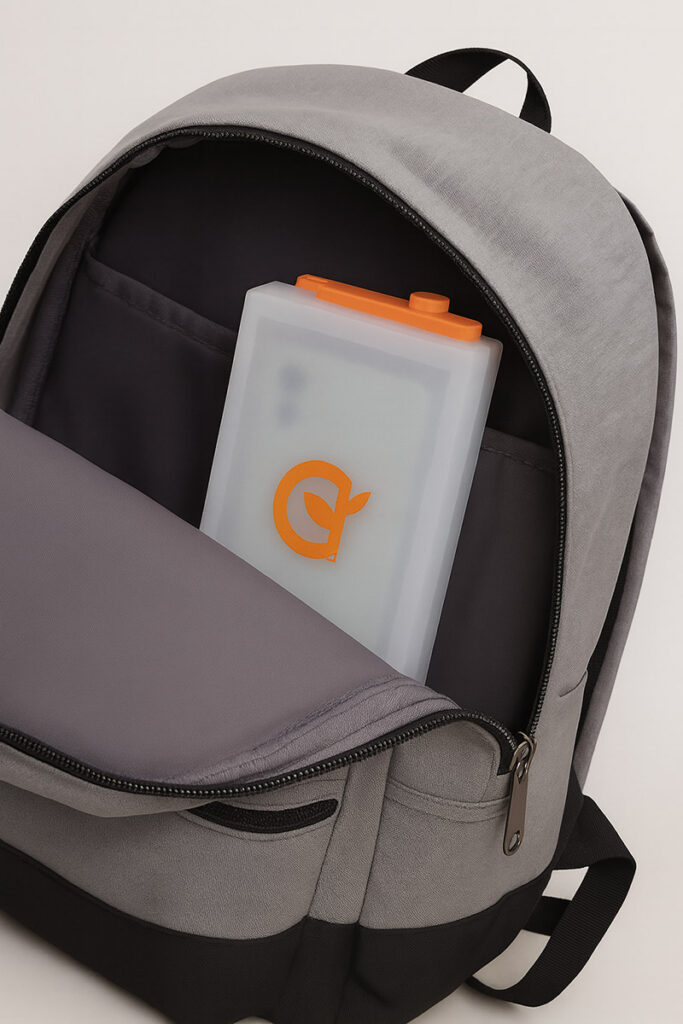
NuKase is different from Yondr in important ways. NuKases are not as costly as Yondr pouches, both as a one time cost and a year over year cost. Also, they are said to be less hackable than Yondr pouches. NuKases are made of the same material that is in bulletproof glass, so it’s essentially indestructible. So ideally the enforcement situation, as opposed to caddies or other storage units will be less significant
What I am recommending at the alternative schools where we have only 130 students, is a centralized turn-in system. So, say I’m a kid, I come on campus, I hand it to my teacher or the front office, and they lock it up in a phone locker. When I leave, my teacher hands it back to me and that’s the ideal way to do it. But we can only do it at an alternative site because that only has 130 kids versus, you know, Tam High with 1,500 kids. Completely impractical. And it’s impractical to say, well, just keep it in your backpack. because we know how addictive they are. So we will purchase these NuKase devices and before the school year starts, you go and complete all the registration forms and you’re going to be issued one of these NuKases. This is yours for four years. Each classroom will have a magnet and every morning the first period teacher will lock the case with the magnet and then the phone stays with the student in their backpack. Seventh period, the days over, I pull this locked case out of my bag and the teacher unlocks it and I get my phone back.
I have had lots of conversations with lots of different teachers on this topic, and some of them were concerned, and have asked, what’s my responsibility? I said, you know, as I see it, you might deal with it only twice a day. If you have first period, you’re going to lock it up, and then if you have a seventh period, you’re going to pull out the magnet for them to unlock it. That’s all you’re going to do with it. I said, right now, you’re having to manage at least 10 times a day. And when I said that to several teachers, they said, I don’t deal with it ten times a day. I deal with phones a hundred times a day! Because students are constantly nagging, saying, “Can I get my phone? I need to check this or I’ve got to text my mom or see something on my phone.”
This system will be so much easier because the phone is not accessible. And if a student is not willing to go through this and lock their phone, they go to the office, or they go home. It’s just like if you were caught smoking in the bathroom. I’m really excited. I think it will be a very good thing, not just for our kids, but I think also for our teachers.
There will likely be some bumps in the road. I’ve spoken to five or six different schools that have adopted either Yondr or NuKase, and they’ve all said that there are some bumps in the road. But not one of them that I’ve talked to said they would do anything differently. Every one of them said that this is the best decision they’ve ever implemented and that it completely transformed their campus.
And what about emergency scenarios?
State law requires that kids be able to access their phone during an emergency. That’s why we’re purchasing the unlocking mechanism for every single classroom.
Anything else you’d like to add about cell phones and education?
We know that phones, smartphones, social media…we know they’re addictive, we know they harm mental wellbeing, and we know they impair learning. We cannot go back in time and not invent smartphones and social media. So we have to do something. No solution is going to be perfect. No solution is going to be without flaws or detractors. But if we go back to the fact that we know they’re addictive, we know they harm mental wellbeing, we know they impair learning, we have to do something. We can’t just sit on our hands and wait for the perfect solution.