
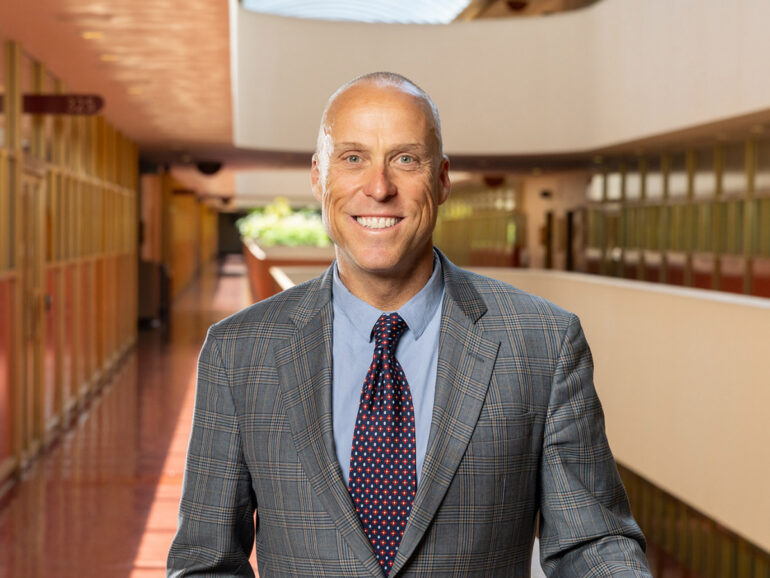
With the country celebrating its 250th birthday this year, there’s no better time to learn — and teach your kids — more about civics. At every level of government there are unseen public servants working each week for the benefit of residents. One of them is prodigal Marin son Derek Johnson, who succeeded longstanding administrator Matthew Hymel when he retired two years ago. Hymel was known for quietly keeping Marin’s finances stable and functional across two recessions and a couple of wildfire crises for over two decades.
Johnson grew up in the 1970s and 80s — living in the same Novato house his mom was raised in — and attended Novato High School. His favorite teacher was Mr. Harms because he “really listened, and he sparked curiosity in students at an age they think they know everything already,” recalls Johnson. He says he had a typical Marin childhood, full of sports, music and socializing – fondly remembering bonfires on Limantour, his favorite beach, and surfing throughout West Marin. Johnson remembers buying his first surfboard, at what is now Proof Lab’s Shoreline Highway location. In fact, surfing was a big draw for Johnson to choose UCSB for college.
Today, with a job that now takes over 60 hours a week, he’s turned in his surfboard for a road bike, and just returned from a 720+ mile solo adventure from Astoria to Marin. Solo wasn’t the plan, but when his friends couldn’t make it, he did it anyway.
Johnson’s family connection with Marin County goes back about 80 years. Thumbing through boxes of photos soon after his mom passed away, he was struck by his deep history here. Both his maternal grandparents were military officers who served in the Pacific Theater during World War II. Hamilton Army Air Base in Novato was one of the busiest bomber bases on the West Coast, and his grandfather was stationed there. Coincidentally, this photo tour down memory lane coincided with a summer course he took at Stanford in 2023, and his professor was the one who let him know of the County Administrator position in Marin. The rest is history.
Marin Magazine caught up with Johnson to discuss his valuable Central Coast experience and vision for our county.
What is it you “do” exactly, as the County Executive at the Civic Center?
My position is appointed by the Board of Supervisors to provide administrative leadership to the County workforce. In the most basic terms, my goal is to advance the Supervisors’ plans and objectives and oversee an annual budget of more than $900 million. All told, we have more than 3,000 people working in full-time, part-time or seasonal roles to deliver much-needed services to Marin’s population.
What’s an average week look like?
My average week, in all honesty, is a whole lot of meetings focused on optimizing County government to deliver the best service for Marin residents. Some of them are thick with policy decisions, and others are more conceptual. The mix keeps things interesting. Top to bottom, those meetings are fruitful and productive. I’m meeting with people who are sharing an idea or making a difference and have similar goals in mind. I love it when I have time to get out of the office and observe people from our various departments doing great work in the community.
What lessons do you value from your time in San Luis Obispo?
I spent 12 years working for the City of San Luis Obispo, and the last six years of that was serving as City Manager. Just like here in Marin, you’re going to have your hands in a huge variety of projects. I think the most applicable lessons I brought up here were about improving efficiencies and addressing the highest priorities set by the community and the governing body.
Also working in Santa Barbara as well (which, like SLO and Marin, has a commitment to a high quality of life) there was a tension about keeping it the same vs. facilitating change. What I learned is that if we don’t have planned change, we experience unplanned decay. To keep high quality communities like Marin thriving, we need to constantly be evolving. And right now with housing pressures that are not unique to Marin, we need to be planning for the community we want, rather than it feeling like it is happening to us.
Which measures created by Matthew Hymel are you continuing?
I share and deeply appreciate Matthew’s commitment to fiscal responsibility and long-term stewardship. In terms of standout measures, Matthew’s leadership on maintaining the County’s strong fiscal position, advancing responsible budget practices and supporting voter-approved investments in parks, open space, emergency preparedness and essential County services are all worth recognizing. Those efforts reflect a legacy of thoughtful governance: balancing today’s service needs with the County’s obligation to remain resilient for future generations.
What is different in your approach versus your predecessor?
Matthew and I have different styles, and that is healthy for any organization. Some people have described Matthew as the backstage manager of the band: steady, disciplined, making sure the lights work, the sound is right and the show can go on. I may be a little more comfortable as the lead singer — out front, engaging the room and trying to connect the music to the audience. But the truth is, you need both roles for the band to work.
We are in a very different time now. With a mind towards the aforementioned unplanned decay concept, Santa Barbara’s State Street is a good example of the mindset of “if nothing changes everything will stay the same.” And I think for folks that are maybe not as comfortable with change, my recommendation is to realize, the change we’re talking about isn’t likely going to happen in your lifetime. We are paying it forward to the next generation. The last generation paid it forward to us and gave us an open space, it’s our turn to pay it forward with better transportation and urban housing systems.
What would you like to see locals get more involved in?
There are several important initiatives where we want and need local involvement this year and next. The first is the Economic Vitality Strategic Plan, which will help shape how Marin supports local businesses, downtowns and commercial corridors, workforce pathways, tourism, agriculture and a more resilient local economy. This work matters because economic vitality is directly connected to quality of life, public services, housing, jobs and the ability of our communities to thrive over time.
We are also launching the Countywide Strategic Plan, Marin County’s first countywide strategic plan in more than 25 years. This effort will help align Board priorities, departmental workplans, budgets, capital planning, infrastructure needs, climate work, equity goals, emergency preparedness and performance reporting into a shared framework for the next several years. It is important because the County is facing complex challenges that require clearer priorities, stronger coordination and measurable results. In addition, we are preparing for an upcoming West Marin effort that will build on local conversations about community needs, infrastructure, housing, agriculture, climate resilience, access to services and the unique character and future of West Marin communities. That work is important because West Marin has distinct needs and opportunities, and the best solutions will come from listening closely to the people who live, work, farm, serve and care for those communities.
In each of these efforts, local voices matter. Strategic planning is not just about what government writes down; it is about how we listen, what we choose to prioritize and how we build trust and shared ownership for the future.
Local residents can follow updates and learn more about engagement opportunities at MarinCounty.gov.
