
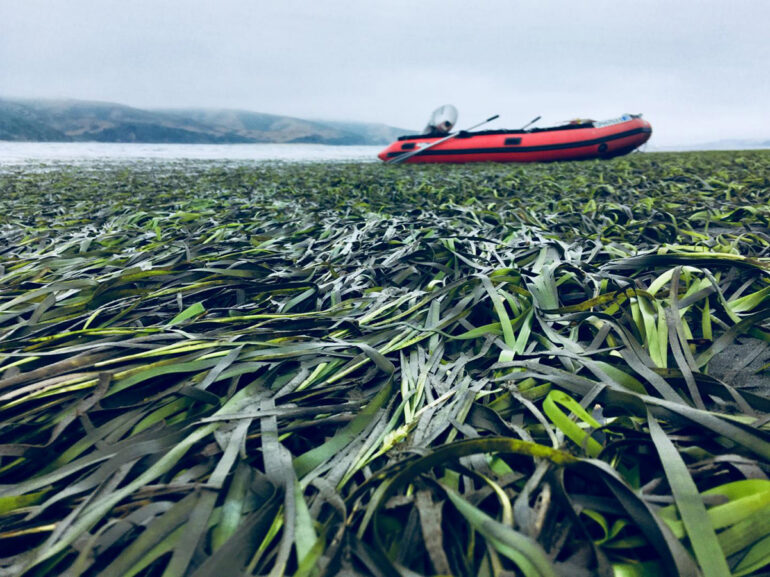
Behold, the humble eelgrass. An underwater meadow, undulating with the slow rhythm of the tides. It has been called the “Sexiest Plant Alive” in Alaska. Among the Comcáac people of the Sonoran Coast it’s known as a superfood. And Danes have been thatching their roofs with it for centuries. Found all over the planet, this unassuming plant plays an outsized role that benefits animals and humans alike. But here in Marin, specifically in Richardson Bay, eelgrass has been struggling for survival. You could say it’s the spotted owl of the Sausalito waterfront — and now local scientists and politicians are rallying to help.
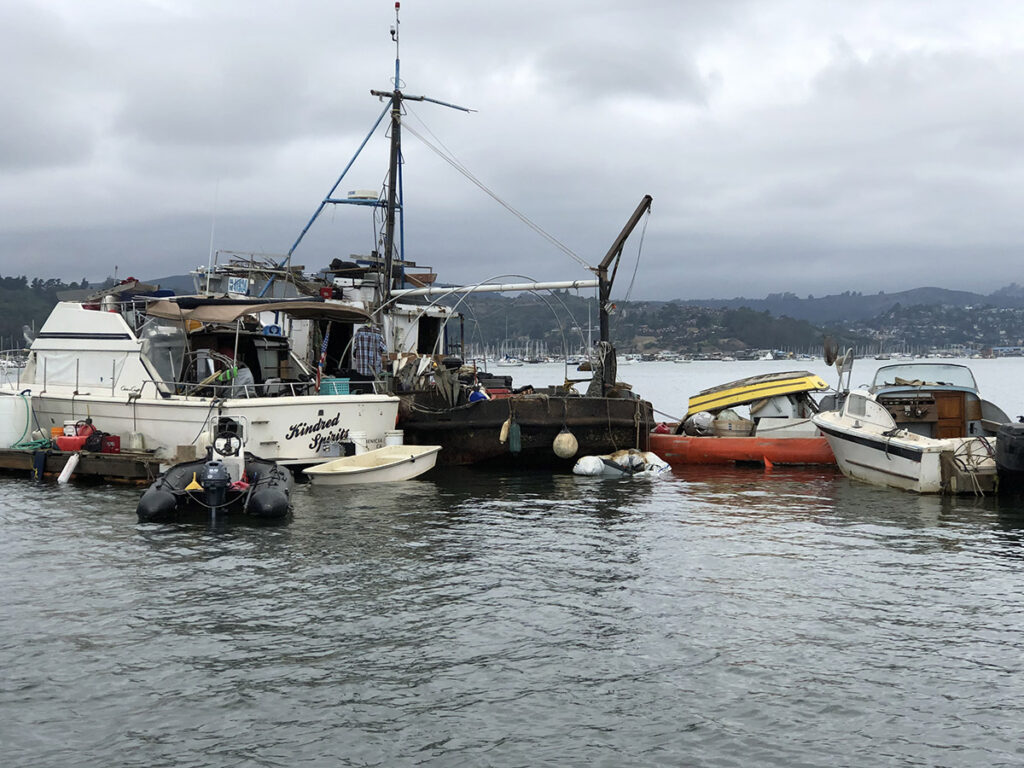
Maybe you recall headlines in the late 2010s about rising tensions among shoreline dwellers of Marin and “anchor-outs” on Richardson Bay. When Jim Malcolm first began working as a harbormaster, he was responsible for tracking a huge swath of boats illegally anchored in the water. In 2020, when Malcolm started, there were upwards of 150 of these boats. Many were abandoned, some with windows you couldn’t see through. “Imagine one of the worst hoarding situations you’ve ever seen and put it on a boat,” he says.
Today, when Malcolm drives to work over Richardson bridge he still glances out his window to see if there are any boats on the water. “It’s actually a pretty chill atmosphere,” he remarks.
There’s a big reason for the change: eelgrass.
Superhero Eelgrass
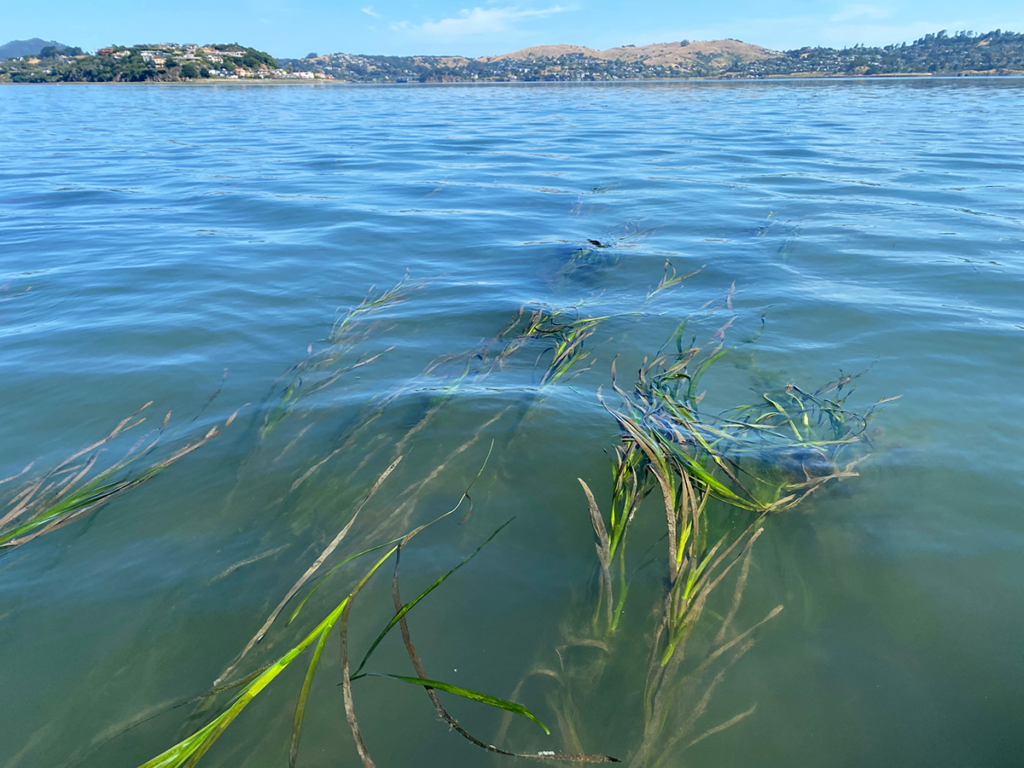
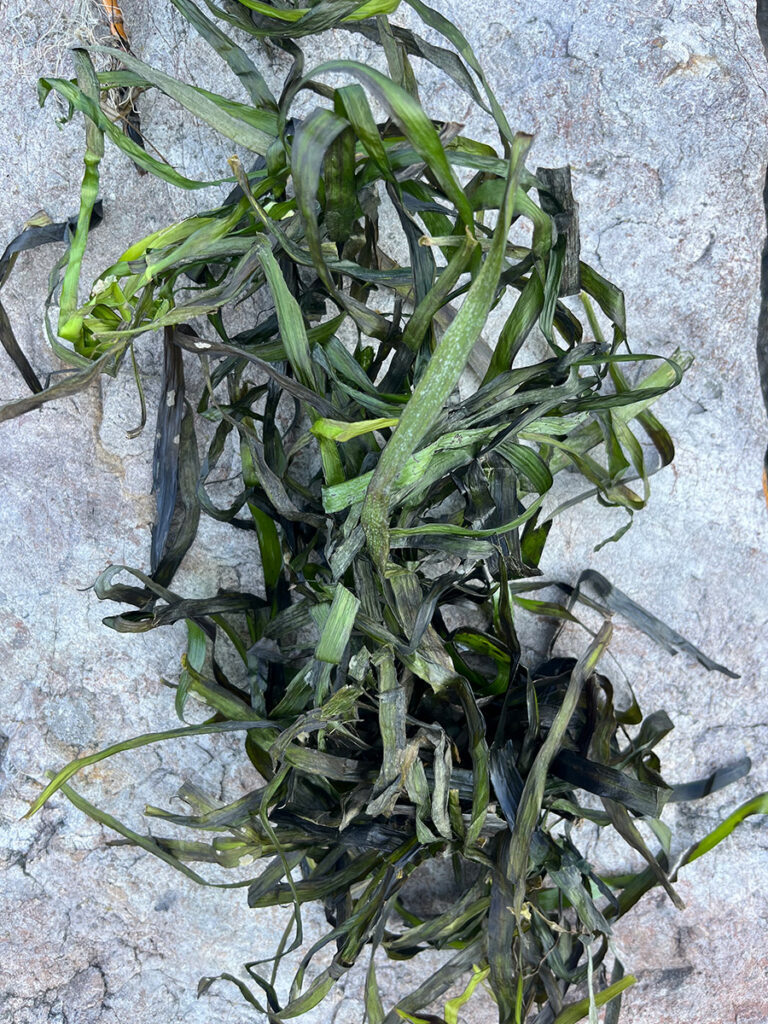
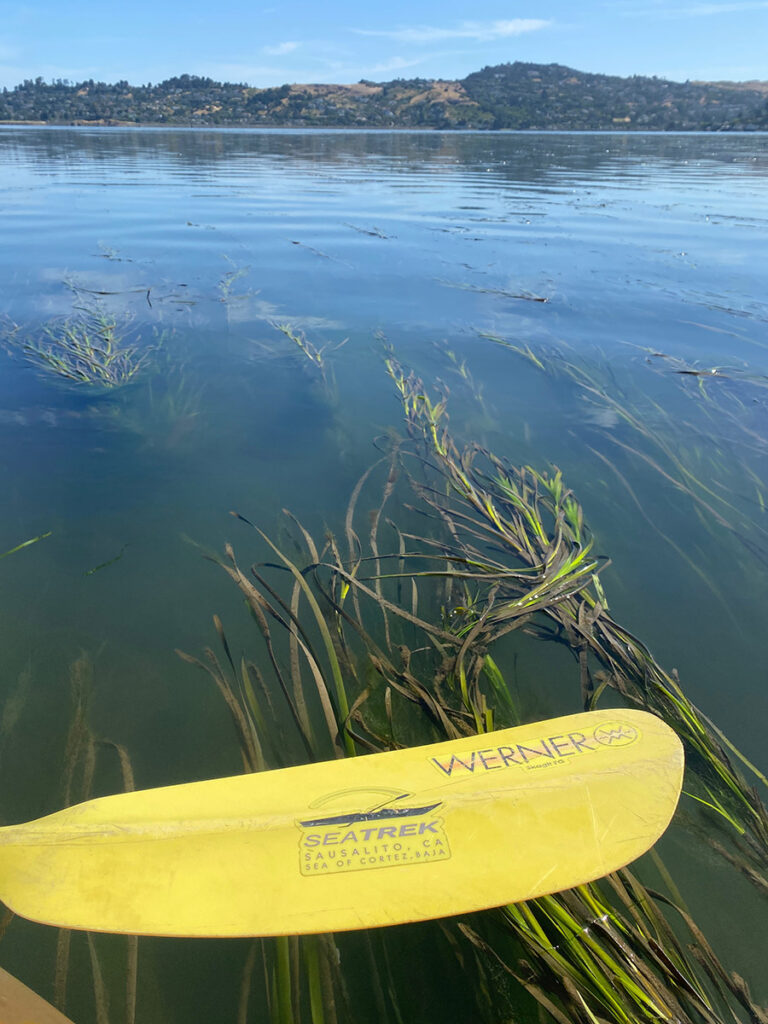
Richardson Bay is home to the second largest eelgrass bed in the San Francisco Bay Area. (San Pablo Bay is the largest.) The flowering seagrass is beautiful to witness with its long blades reaching towards sunlight. It thrives in shallow, cool waters and is home to tens of thousands of waterbirds who shelter and forage among its beds. The blades of eelgrass literally hold life: Pacific herring, jack silverside and leopard sharks lay their eggs in it.
In addition to providing refuge to animals we see — and some we don’t — eelgrass is a climate superhero: a powerful “blue carbon” ecosystem that sequesters carbon up to 35 to 70 times faster than tropical rainforests. Healthy eelgrass meadows “improve water clarity by trapping sediments, sequester carbon and nutrients, and buffer shorelines against erosion,” according to the Audubon Society, which has a bird sanctuary in Richardson Bay.
Underwater Crop Circles
The illegal boats were becoming impossible to ignore for Jill Hoffman, who served on Sausalito’s City Council and as vice-mayor and mayor during this time. “The city of Sausalito had already been working on a solution for the boating blight,” she recalls, “because many of the residents were upset by the floating debris, and the seeming lack of a plan to deal with it.”
Then it became apparent that the anchor-outs were destroying the eelgrass. In imagery from airplanes and drones you can see near-perfect circles, or mooring scars, created by anchors embedded in the loose mud of the bay floor. Some of these scars were an acre in size. Harbormaster Malcolm explained these were caused by a boat’s “scope of line.” When a boat is anchored the motion of the tide coming in and out drags the boat around its anchor in a perfect circle. “The line acts like a lawnmower,” he said.
Or a weed whacker plundering a delicate ecosystem.
A Complicated Task
The anchor-out issue finally came to a head in 2015 when there were 250 boats illegally anchored off the shore of Sausalito. “Regional management pressures elsewhere in the San Francisco Bay, combined with the failure of the then-existing Richardson Bay Regional Agency [RBRA] management to control the influx of vessels,” said Hoffman, “… allowed the number of vessels and volume of marine debris to reach an unmanageable critical mass, which caused significant damage to the marine environment, including the eelgrass habitat.”
Many thought this was such a complex problem touching on so many civic and environmental elements that it was uniquely unsolvable. And for a while it looked like they were right. Sausalito City management was not happy with the ideas being presented by the Richardson Bay Regional Agency (RBRA), a local government agency serving Belvedere, Mill Valley, Tiburon and unincorporated Southern Marin that was dealing with the issue. Sausalito started its own independent Waterfront Management Plan, going from 90 to nine vessels in the span of 18 months.
“We withdrew [from RBRA] in 2016 when their ‘solution’ was to construct a 200-boat mooring field in County waters and move all the boats and floating marine debris onto those moorings,” recalls Mayor Hoffman. “Sausalito was expected to fund 37% of it and absorb all the impacts.” However, Hoffman continues, “That was under different management, and the bottom line is that everyone wanted to get to the best solution for our beautiful bay.”
RBRA and the City of Sausalito eventually found common ground when RBRA adopted a plan similar to the one created by Sausalito to solve the problem. Today, RBRA is the group most people credit for really getting the ball rolling to save the eelgrass. The backbone of that project was Kathy Boyer, executive director of the Estuary & Ocean Science Center (EOS Center) in Tiburon. “Eelgrass is a carbon sink, a habitat and an ecosystem,” Boyer said, speaking to its vast potential. And she should know, she’s been studying and working in eelgrass restoration since 2006.
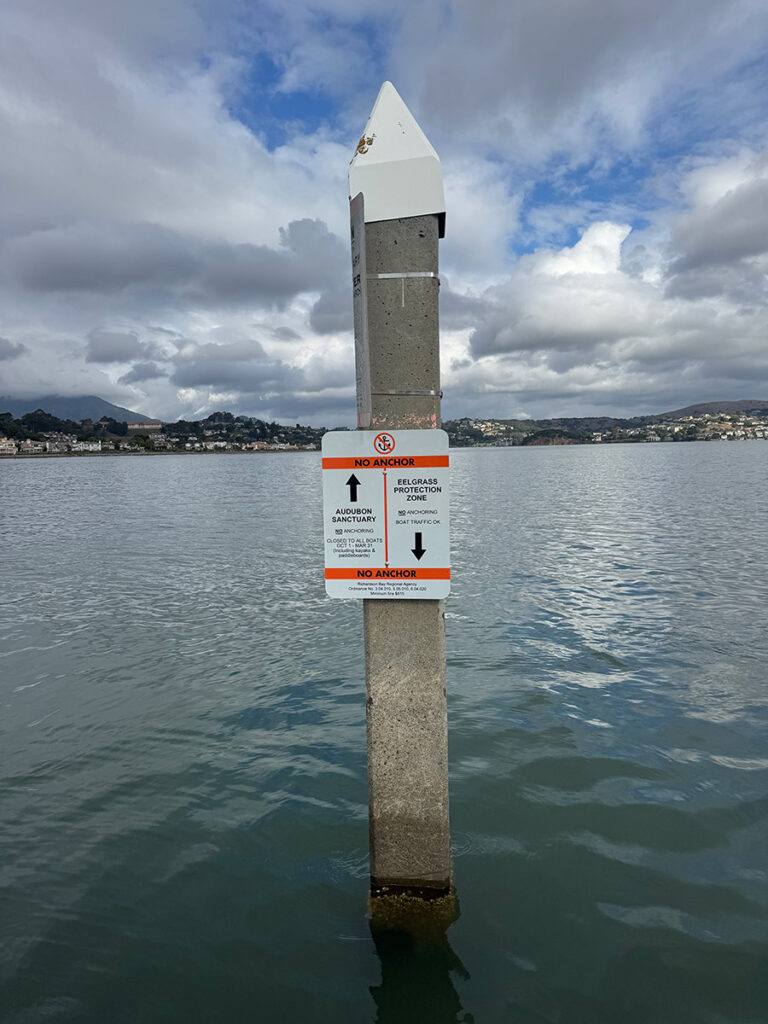
According to the new plan, RBRA first needed to establish a 700-acre zone that would be off limits to anchoring. This became the “Eelgrass Protection Zone” or EPZ; an area about the size of Angel Island. Adjoining the EPZ, also boat-free, is a 900-acre area overseen by the Audubon Sanctuary in southern Tiburon. Beyond these is a third area, far from the meadows, where boats can remain up to 72 hours without a permit.
Next, RBRA worked with Boyer and several other consultants on a proposal to replant the EPZ. In 2023, they landed a $2.8-million grant from the Environmental Protection Agency. Boyer created “planting designs” and a framework for how to approach areas with and without boats. Not only would they focus on replanting eelgrass, they’d learn from doing it. “We squeezed science into the project,” she said.
A Garden of Eelgrass
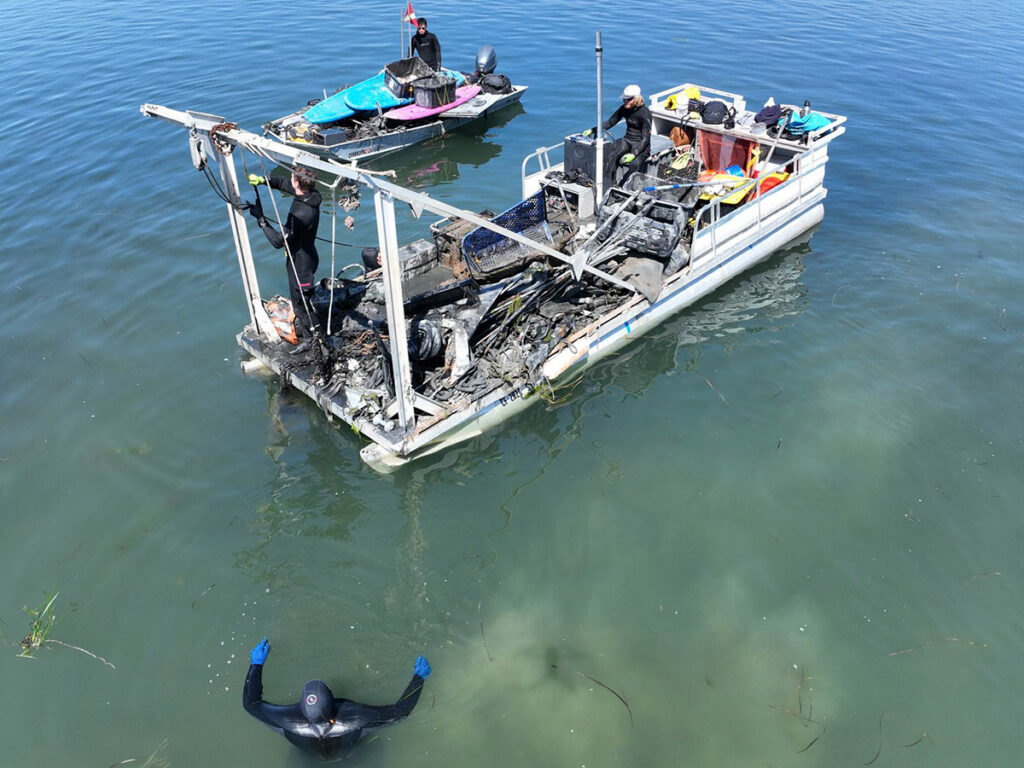
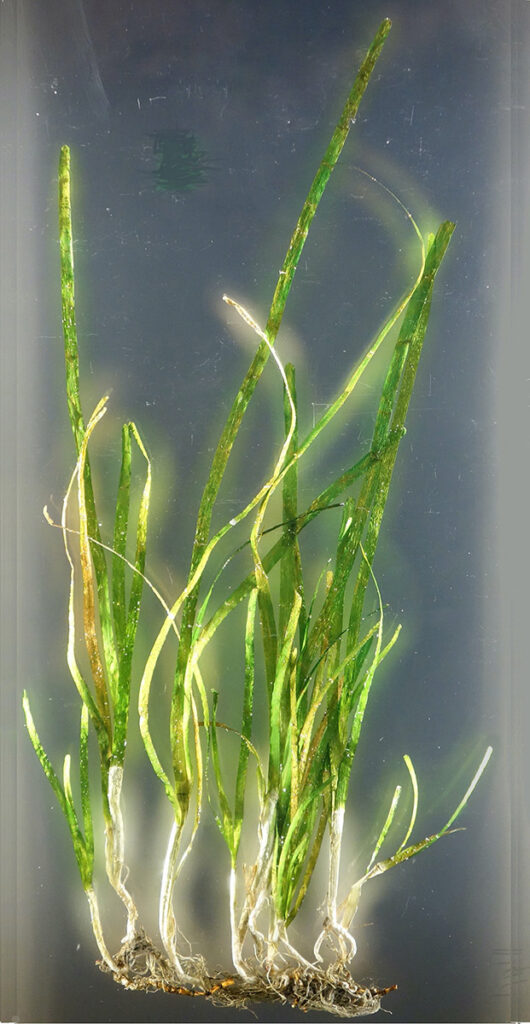
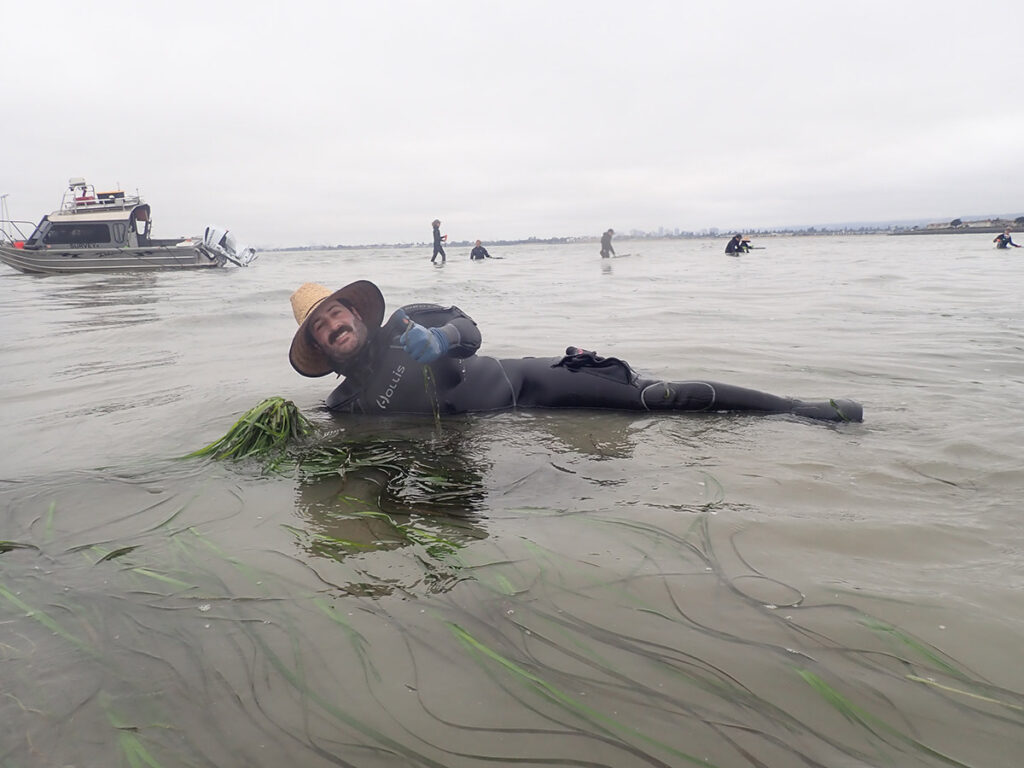
Eelgrass planting is best done at low tide. While Marin residents are well acquainted with the flooding from king tides, the upside is beautiful low tides. The work isn’t complicated but must be done in a short window. Divers gently dig up individual shoots with their fingers from healthy local beds and take them back to the EOS Center. Transplants are held for a short period in tanks filled with cool, clear bay water. To ensure plants stay in place once planted, they’re affixed to paper sticks with string. “These serve as a biodegradable anchor,” Boyer explained. “Then we load them onto a boat and go to the next planting spot.”
Her team is cranking. They’ve already replanted 16.5 acres using the EPA funds, more than the goal, and will continue to replant into 2027.
You might wonder whether plants need help recovering within the mooring scars or if they’ll repair by seeding themselves naturally. Boyer said that “larger areas are likely to benefit most from active restoration.” But because science relies on experiments, they’re leaving unplanted areas within their restoration design so they can learn whether self-recovery is possible.
Today, if you go out on Richardson Bay, it’s nice to know that underneath that blue water are the results of this painstaking work — a new field of baby eelgrass.
Back on Land
And what about the boats moored in the EPZ? Alongside focus on the natural habitat, local Senator Mike McGuire secured $3 million in state funding for supportive housing. The Marin Housing Authority administered the voucher program and enabled many of those living full time on fragile vessels to move permanently on land or get help making their boats seaworthy. The numbers were astonishing. In 2017, there were 94 boats in the EPZ. By 2025, there were six boats. This past August, the final eligible participant was moved into safe housing. There is just one vessel left, and the owner is enrolled in RBRA’s Safe and Seaworthy Program, which gives them until October 26, 2026 to fix their boat and, perhaps, sail away.
“This program is proof that we can show people being housed safely and effectively and restore local ecosystems: native eelgrass, breeding grounds for local communities and increased bird activity,” said Jess Bode of Coastal Policy Solutions, one of the consultants on the project. Thousands of pounds of debris left by the former anchor-outs, including entire boats, have already been removed to make room for new eelgrass. Now, Bode is working on more grants, including a multi-million-dollar grant to remove over 700 more tons of debris.
Boyer is in the wings ready to replant more eelgrass when it gets the green light.

EELGRASS — A Very Important Plant
Protects shorelines from erosion
Cleans polluted water
Produces oxygen
Fights climate change by storing greenhouse gases
Provides homes and food for fish, crabs and migratory birds
FUN FACTS:
Eelgrass is not a seaweed: it’s a true marine flowering plant with roots, stem and ribbon-like leaves.
One colony of Mediterranean eelgrass off the Ibiza coast is said to be 100,000 years old.
Mattresses stuffed with dried eelgrass were used in French barracks in WWI.