
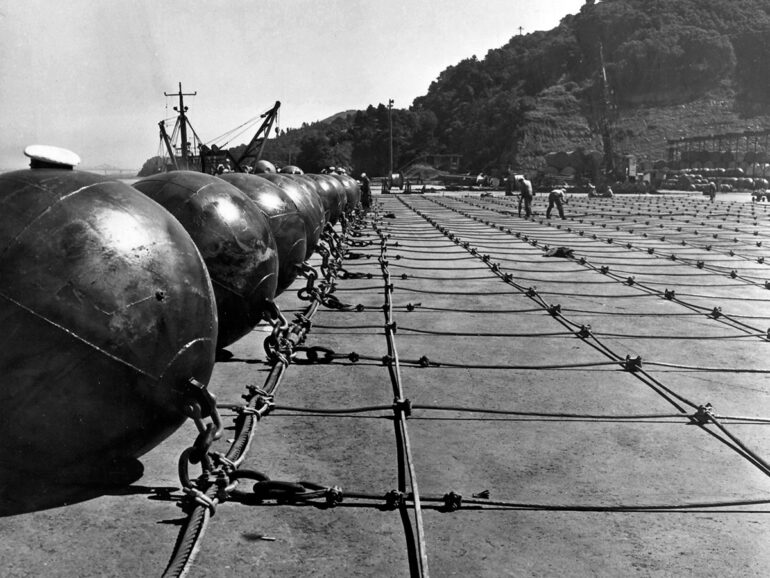
On most afternoons, 85-year-old retired doctor Jerry Gardner sits on his De Silva Island deck and stares at the placid waters of Richardson Bay. A seagull will often glide in and settle on what Gardner assumed was the rounded top of a boulder protruding up from the bottom of the bay. But upon closer inspection, the good doctor realized that it wasn’t a protruding boulder the seagull was landing upon… it was a huge metal buoy. And, after checking with a friend steeped in local history, he learned that 85 years ago, at the start of World War II, that huge metal buoy was one of hundreds that held up an underwater steel curtain that stretched for seven miles from Sausalito to San Francisco across the Golden Gate.
Its purpose was to keep Japanese submarines from entering San Francisco Bay. The curtain weighed 6,000 tons and was held in place with 25-ton blocks of concrete known as “clumps” that settled on the floor of the bay. At the time, the Japanese were two months from attacking Pearl Harbor but after what German U-boats had done to allied shipping during WWI, the U.S. Navy wasn’t taking chances. And oh boy, were those buoys enormous. Made of metal and standing 10’ tall, they were 13’ around. The above photo shows a section of the steel curtain being assembled on a football field-size concrete pad specially constructed for that purpose in the U.S. Naval Net Depot in Tiburon (In recent years, this site was the Romberg Tiburon Environmental Center, then San Francisco State University’s Estuary & Ocean Science Center. The 53-acre parcel along Tiburon’s Paradise Drive — acquired by the government in 1904 — will be closed indefinitely at the end of this month).
From the Net Depot’s concrete slab, the bulky steel anti-submarine curtain was dragged into place section by section by net tenders until the seven-mile curtain was completed. Using current landmarks, it stretched from Cavallo Point Resort on the Marin side to the St. Francis Yacht Club on the San Francisco side. There were gates at each end to allow friendly ships to pass through with prior notice. Although Japanese subs were known to have prowled the California coast, none ever became ensnarled in the Navy’s massive underwater metal curtain. However, according to an account published in SF Gate, as the anti-sub net was being installed in September of 1941, it did snag a lumber schooner heading from Oregon into San Francisco Bay. She was the Daisy Gadsby, and two Navy tugs soon freed her.