
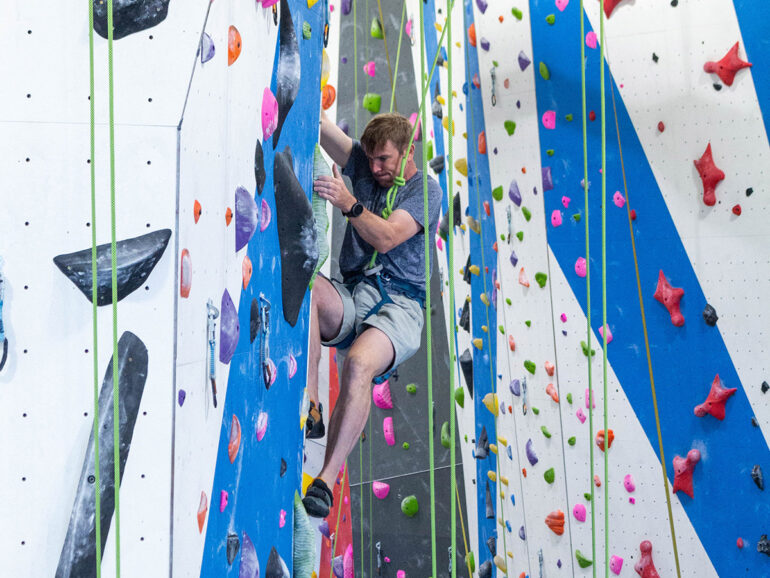
San Rafael resident Nikolai Mihalko was stocking books at his REI job when he came across the title Bay Area Bouldering. Until this point, his perception of rock climbing was synonymous only with extreme expeditions like trips up Mount Everest. He thought to himself, “Alright, how do you turn a boulder into a verb?”
A few days later, Mihalko had finished the book and found himself outside, attempting his first climb.
“I could honestly tell you, as soon as my feet left the ground, I know what love feels like,” he says. “Everything up into that point felt like a complete waste of time and I have been climbing every day since.”
Now, Mihalko is an instructor at the San Rafael indoor climbing gym, Gravity Vault Marin. He’s also just one of many Marin residents with a fervor for scaling the sides of mountains or traversing up indoor walls.
The Evolution of Climbing
According to National Geographic, the history of climbing dates back centuries, rooted originally in necessity to stay clear of danger or to travel. It wasn’t until the 1900s that climbing gained traction as a hobby and it took until the 2020 Tokyo Olympics to be added to the summer Olympics. Closer to home, the popular climbing gym in Marin called Class 5 opened in 1990, but closed in 2008. This left Marin void of climbing gyms for more than a decade, until the Gravity Vault Marin opened in 2021. It remains Marin’s only climbing gym to date.
What is it?
Climbing is an endorphin-fueled sport that is done either indoors or outdoors. Both categories are further split into different sub-types, like bouldering, top-rope climbing (the anchor is set at the top of the route and a rope runs down from it) and lead climbing (in which the rope runs directly between the belayer and climber, and the climber clips into fixed bolts as they move up the wall).
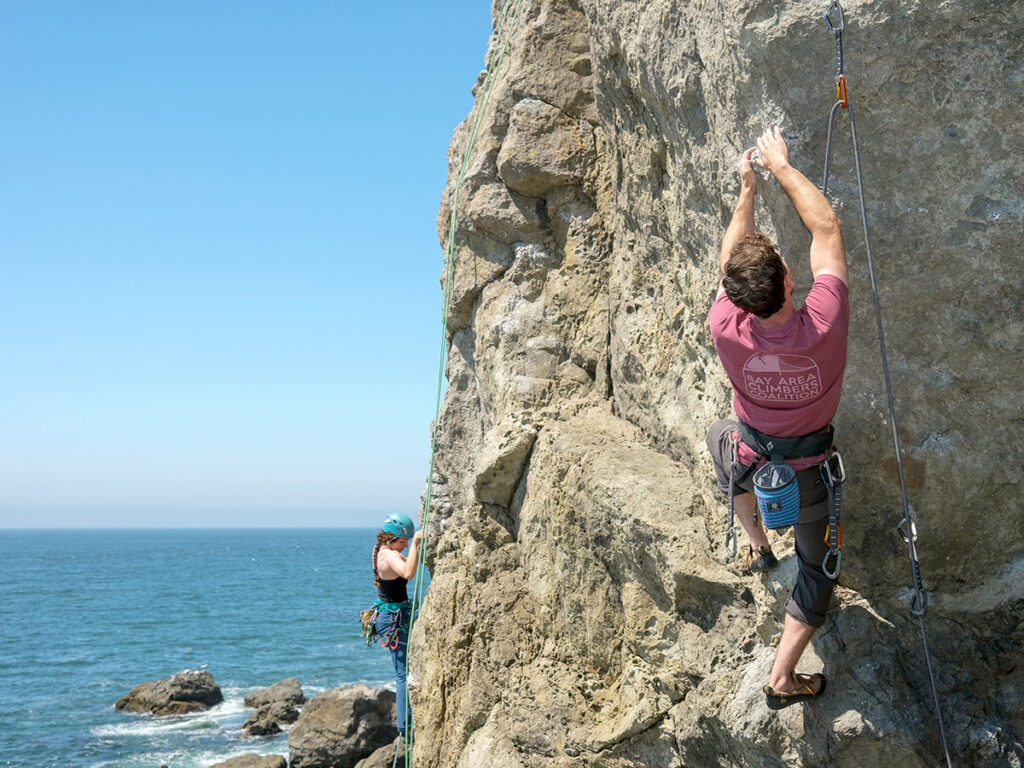
Outdoor climbing also includes variations of lead climbing — sports climbing, in which the climber clips into pre-placed bolts, and trad (traditional) climbing, in which the leader brings all of their own gear with them and no pre-placed bolts are used — plus aid climbing, free climbing and free soloing. This form of the sport is also far more technical and inherently more perilous than climbing on an indoor wall: surfaces can change, weather can be unpredictable and you can’t know for certain if any potentially existing holds will be stable.
Talk the Talk
What are some terms you might hear?
- On Belay: Means it’s safe to climb because your climbing partner has the rope secured
- Beta: The body positions and sequence of moves needed to get through a climb
- Spray Beta: To give unwanted advice to a climber
- Crux: The hardest part of a climb
- Send: To climb a route without falling (“I sent it!”)
- Pumped: The way your forearms feel after a hard climb (“ I am so pumped!”)
- Whipper: A longer fall when lead climbing
- Projecting: Trying a hard climb many times until you “send it”
- Small Box Climb: A climb that is easier for short people
- Big Box climb: A climb that is easier for tall people
- Sloper: A large round climbing hold
- Crimp: A small edge that is just enough for the tips of your fingers
Who are they?
Climbing is an inclusive activity, spanning from as young as elementary school children to retirees. Scott Sklar, owner of Gravity Vault Marin (GVM), emphasizes that there’s “a huge diverse range” of climbers.
He first points to Brock Wagstaff, who is one of Sklar’s most seasoned visitors and has more than 50 years of climbing to his name; Linsay Bodenheimer and Natalie Khorochev are two of a few young moms who frequent the gym as well. After school hours typically draw a much younger crowd, but you may also see climbing classes hosted by PD Connect in collaboration with Up ENDing Parkinson’s are composed of people living with Parkinson’s, as well as volunteers and caregivers.
“Climbing is for everybody. I think the only barrier of entry can be gear. If you can get past that, it’s really for everybody,” says Khorochev, who has been climbing since she was in college.
There are also those who see climbing as a way to mix their love of the sport with a cause they’re equally passionate about.
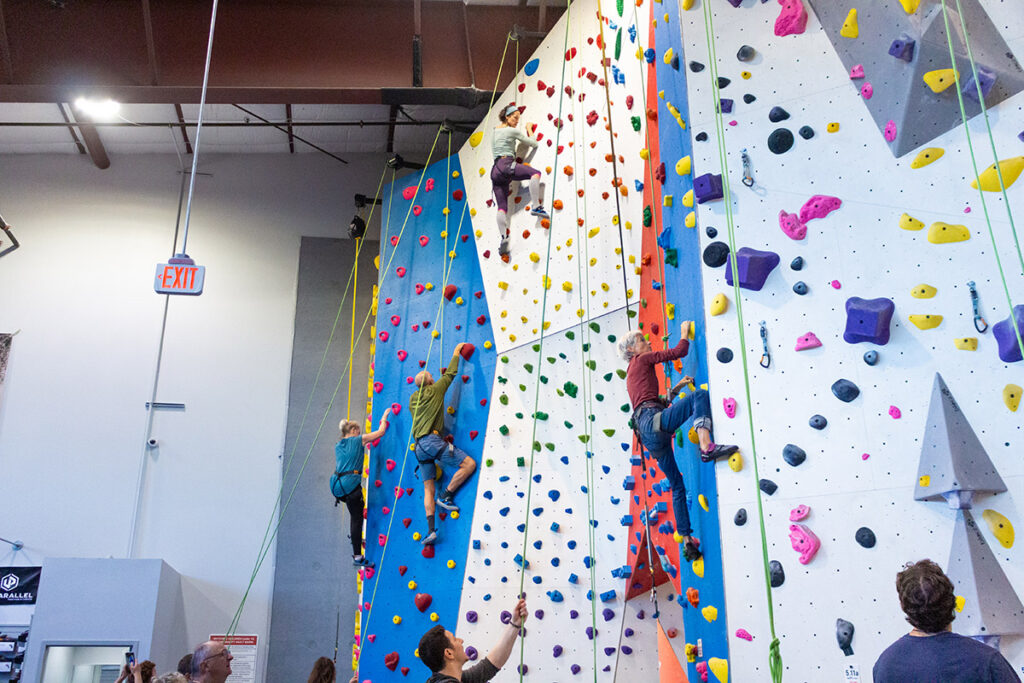
“I would say a lot of people use the climbing community as a way to identify with a group of people, and there’s no shortage of ‘affinity groups,’” says Bay Area Climbers Coalition’s (BACC) president Patrick Lerchi.
Among these identity groups are Escalemos, FilipinUp, Black Rock Collective, Queer Crush, Wall Dolls and Chicks With Grit, which extend past Marin into the greater Bay Area and even into the broader nation. “Amplification of these marginalized and historically excluded individuals is necessary to develop a safer climbing culture that is actually inclusive and equitable,” BACC Community Director Cristina Bourassa says.
As a whole, the BACC is a volunteer-led nonprofit that serves as a resource to the community to “translate gym habits to crag etiquette,” Bourassa says, and to fulfill its mission of preserving access to climbing through stewardship.
This stewardship — which keeps these outdoor climbing environments clean and accessible — involves collaboration with land managers of all different sectors, including private, state, regional and local. Beyond this, the BACC is able to share its cause with the public through activities like frequent trash pickups, trail building and maintenance. The result? A mindful and educated outdoor climbing community.
Why do they do it?
For some, it’s the endorphin rush that comes with navigating a particularly tricky bit of a course or finally reaching the top. And for climbers like Lerchi, the feeling is incomparable. “On the way back down from reaching the top of [a] route, there’s no other feeling like it because you’ve put the sweat equity into it, and then you’re just overwhelmed with where you are, the achievement that you’ve made and just soaking all that up,” he says. “It requires that work for it to have that level of value.”
The built-in, tight-knit community is also a draw. Mihalko feels that climbing is different from other activities (like hiking) and really allows members to form close bonds. “With climbing, you really do develop a trust with the people that you’re climbing [with]. So it’s kind of an intimate way to connect and bond with somebody,” he says. “I’ve made some of the best connections with people through climbing or friends that are probably gonna be with me for the rest of my life.”
Bodenheimer, much like Mihalko, has formed close friendships through climbing. But it’s also allowed her to find an activity that both her and her family can enjoy. “It’s filled so many cups in my life. My kids love to climb. My husband climbs, like we’ve made trips around outdoor climbing,” she says.
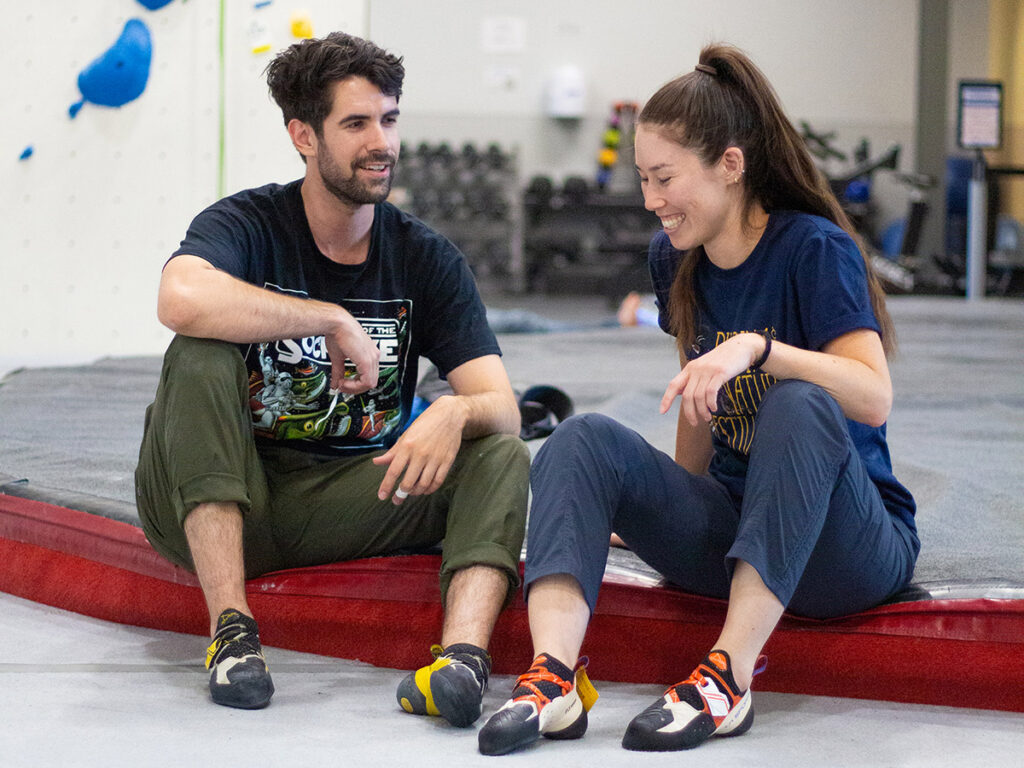
Then there are the health benefits. Rock climbing is scientifically proven to be a great form of exercise. One study published in the National Library of Medicine called Energy Expenditure and Physiological Responses During Indoor Rock Climbing found that climbing requires the same energy necessary to run an 8- to 11-minute mile. Even still, the energy is expended differently.
“[It] can feel really hard at the beginning. You’re using so many different parts of your body that you probably don’t use on a daily basis. So start slow. Don’t get discouraged,” Khorochev says.
There are also substantiated psychological benefits of climbing — a different study found that just over 73% of participants agreed that climbing positively impacts mental health. This could stem from the camaraderie, or from the level of concentration that it requires. “Every climb is like a puzzle. It demands a level of focus and commitment that’s addicting,” Lerchi says.
Where do they do it?
Though the county is limited in its indoor climbing options, Marin is still an ideal place for avid or prospective climbers. As Lerchi puts it: “It’s part of the culture in a way that it’s not in other parts of the country.”
The Bay Area nature offers an unparalleled blend of mountains and coast, meaning outdoor climbs are plentiful and beautiful. Lerchi started his own climbing career on the Marin coast towards Muir Beach or Stinson Beach; sometimes he’s even treated to sights of dolphins and whales along the coastline while the sun is setting.
As a regular climber, Lerchi’s recommended Bay Area spots are Vent #5 out at Stinson Beach, St. Helena, Castle Rock and the Berkeley Crags. Some additional climbs known among the community include bouldering at Ring Mountain in Tiburon or at Black Sand Beach, located within the Golden Gate National Recreation Area.
How can I become one of them?
For those looking to get into the sport, starting in an indoor gym, like GVM, offers a lower risk experience with fewer variables at play. This means new climbers can focus on the basics and technique instead of the technical demands that come with outdoor climbing.
Classes are a great way to make sure you’re learning how to climb safely and correctly. GVM and BACC both have many climbers available to share advice and expertise, and outdoor supply stores like REI can help with building out your climbing equipment kit. For a more affordable option, REI even has an option to buy or trade in used gear, or you can choose to rent gear from places like Sports Basement if you aren’t looking to commit just yet. But, GVM recommends purchasing your harness and helmet from new to ensure both are at optimum safety.
Finally, seek out mentorship as another way to improve technique. “Look for mentors who are stronger climbers than you instead of building everything from scratch,” Lerchi says. “The people are here, the people are open and friendly, and that’s the best way to progress and to explore.”
So the next time you think of rock climbing, keep in mind that it’s not necessarily just for adrenaline junkies or the fearless — it can be anybody’s sport.
Stay Safe
- Get instruction from the staff at the climbing gym.
- Always double check each other’s knots.
- If you boulder, learn how to land properly.